


 Posts



Cyprus is very well known for its periodic droughts and low waterfall winters causing severe scarcity of water. This characteristic has been the rule through its long history until today. The city of Larnaca at the south coasts of Cyprus was born at the beginning of the 2nd millennium B.C. as the island’s major port, due to the need of exporting the copper richness of the island, wood, salt from the nearby salt-lake and the other rich products of the island. Imports included food items, handcraft items, jewelry, olive oil and many other products from the nearby civilizations. The choice of the site was due to the excellent natural port facilities and not due to the availability of water, which is the rule for the majority of prehistoric and early settlements.
Contacts and trade exchanges during this period were archaeologically proven with the civilizations of Egypt, Syria, Phoenicia, Palestine, Crete and the Aegean. The city was originally known as Alasia (the place of the salt), but after the first millennium B.C. was known as Kition (Grail – Kivotos). The geographical position of the city, opposite the great civilizations and powers of the World soon made it a strategic navigation point in the Eastern Mediterranean. Its fiord-like natural ports hosted the ships, the wisdom and frictions of all above mentioned civilizations.
The first settlements in the area of Larnaca in the second millennium B.C., soon became the first urban centers of Cyprus. Population increased and the water availability for the local population and for the visiting ships was a subject, which caused a little problem. Due to the absence of any major stream around the port facilities of the first settlements, especially during the long hot summers, the early population of Larnaca made their own wells. At the beginning, the water supply from these wells was sufficient and the water always cool and pleasant. Storing water in the locally made clay water jugs, left in the shade and in the constant Cyprus summer breeze, produced cool and pleasant drinking water. If this valuable forgotten wisdom is reapplied, it is possible to save energy even today.
In both early settlements of the Larnaca area, archaeologists found extensive and stone protected wells, dating in the beginning of the second millennium B.C. They were extensively found in almost all houses and public buildings. Some of these fine stone protected and build wells is thought to be the work of the religious authority of the city, which at the time was also the political authority of the city. Around these wells, archaeologists found holy gardens and intensive plant growing. The city underground water is now at the face of being used in organized agriculture. There is now an overdue use and deeper excavations for more water quantities started to affect the quality of the water, as the sea is very near.
The city became noticeably bigger towards the end of the second millennium. The conflicts with the surrounding powers and civilizations obliged the local authorities to built a mad-straw and stone city walls, around the 13th century B.C. At the end of the 13th century the Mycenaean Greeks controlled the city and they constructed cyclopean walls. But, the population within the city walls since Archaic Times (700-480 BC) increased tremendously. A new method for extensive underground depositing in clay – argil cisterns have been discovered by the archaeologists dating in this period. Depositing water underground is a very wise method, as it is always cooler and safer for drinking, especially in hot climates like Cyprus. The combination of low temperature and darkness makes the possibility of developing bacteria or other dangerous microorganism in water almost impossible. This is a piece of mind of the ancient populations, which modern man forgot to a great extend.
A tomb inscription of the archaic period in Cyprus (700-480 B.C.), found in the Kition cemetery of this period, refer to the “Minister” of the king responsible for the water supply of the kingdom, an officialdom held by his family, as the inscription mentions, for six generations before him! Therefore, organized, wise, efficient and official administration of the water needs of the town can be traced even before the Archaic Period (700-480 BC). Good planning for sufficient quantities of water was in the minds of ancient civilizations to a much greater degree than we think or do today.
The greater needs for good drinking water for the constantly increasing population living within the city walls obliged the Kingdom of Kition authorities and the Minister for the water supply of the city, to import the wisdom and experience of other nearby civilizations. During the Persian overrule of Cyprus (546-335 B.C.), the technology of “Persian Quanats” has been imported by the city. This technology seemed to be known even before the Persian presence on the Island, as the Assyrians, who ruled the island for about 50 years in the beginning of the 7th century, new this technology and applied it for their own cities.
The last part of a long “Persian Quanats” underground channel-system has been discovered in the early 1990’s in recently in the ancient port of the Classical times of Larnaca (480-300 BC.). This sophisticated water supply system was obviously bringing sufficient quantities of water from appropriate sites outside the city walls. The size of this channel in the site of the ancient port is quite large and must have satisfied the needs of a populous city and of a busy military and commercial port. The building technology of the “Persian Quanats” was so wise, that remained in use for more than 2000 years later. These underground channels were bringing with the flow of water large quantities of cool air, therefore supplying the community with freshness in the hot months of the summer.
In the summer of 45 AD, Saint Barnabas and Evangelist Marcus passed by Roman period Kition. In the book “Secret Acts of Saint Barnabas” written by Saint Marcus, a detailed account of their visit in Larnaca is mentioned. A long stay for refreshing at the public aqueduct of Kition is well described. The city was then at its most populous face and the operation of public aqueducts was a mere necessity, which the Roman and later the Byzantine State policies are known to have financed and encouraged in great devotion. Archeological findings of this period in Larnaca show extensive distribution networks with clay pipes, which seem to carry water through small valleys and hills despite the general unscientific view of the Romans that such thing could not happen. At least one such aqueduct was found to operate in Larnaca. Hydraulic wisdom in Larnaca pre-existed Pascal?
In Medieval times, in the book of the chronicle of “Leontios Machairas” written in the 14th century A.D., we find the information that grain mills operated in Larnaca, and that Luzinian King Peter I supplied his army and fleet with flour for people and for the horses of his cavalry from Larnaca. This information is given in relation to the preparation of the military expedition of King Peter against Alexandria-Egypt. Without being able to prove it archaeologically as yet, we assume with a great degree of certainty that these gain mils worked on the main Persian Quanat system of Larnaca, still being repaired and used since Classical, Roman and Byzantine times. The use of hydraulic power in Cyprus for the operation of grain mills was a real achievement for the medieval engineers of the island. The Venetians (1486-1570 A.D.) de-routed the stream of this Persian Quanat system, so it would not pour in the salt lake, when there was a year of plentiful rainfall. This was very necessary as the production of salt, which was a great source of income for the Luzinians and Venetians, was negatively affected when there was too much water in the lake, which would not dry on time to allow the collection of salt.
At the time that Larnaca became once again the main port and populous center of Cyprus, in the Ottoman times, but especially between the years 1746-1878 AD, the Ottoman Governor of Larnaca “Bekir Pashia” (1746-1748) claimed that he constructed a new Aqueduct for Larnaca. A 15 kilometers long aqueduct, with 7 kilometers long underground Persian Quanats channel system initiating at river Tremithos, and with an 8 kilometer long over ground channel passing through 3 different small valleys over arched beautiful constructions, all in excellent condition until today. All these together with the 2 surviving grain mills on the channel, comprise a great monument of the water wisdom of the area. The administration document of the quanat water of the Bekir Pashia aqueduct is surviving too. However, a closer look at the above mentioned archaeological and literal evidence, indicate that the Bekir Pashia aqueduct was an extensive reparation and renovation of pre-existing installations of the ancient aqueducts of the city.
The Bekir Pashia aqueduct system, with all the condensed wisdom of antiquity in relation to the administration of public water-supply, was in full operation until the 1950’s. Its operation was destroyed, not because of less amount of waterfall on the island, but because of the unwise actions of our generation. Over pumping in the water bed of the sourcing of the aqueduct became so great that gradually lowered the underwater level of the whole area. A natural source for the water supply of Larnaca ceased to operate! Modern Technology, used in an unsustainable manner brought its end after perhaps more than 2.5 thousand years.
Larnaca 21.03.2009
Alexis Michaelides
Deputy Mayor.
Writer and independent researcher
Friday, April 3, 2009

Thursday, November 27, 2008
Environmental Activities of the Larnaka Municipality
The municipality of Larnaca is involved in many areas of environmental protection:-
By law it is directly is responsible for:-
• Household garbage collection.
• Hygienic disposal of town waste.
• Hygiene of food, restaurants, shops, tank water etc.
• Road and open space cleaning.
• Development of parks, green areas and town ecology.
• New responsibilities after accession in the E.U.
Takes care of ecological domains as partner in other organizations:-
• The Larnaca Sewerage Board.
• The Committee for the Protection of the Larnaka Salt Lakes.
• The Larnaca Board for the Recycling of Household Waste (still not ready under law)
• The Larnaca Lab for Pollution Watch.
• The Blue Flag program for the cleanliness of seawater.
Plans for better urban environment through municipal decisions for:-
• Traffic control.
• Town mobility
• Public Transport.
• Pedestrian streets and areas.
Uses its authority and influence to control polluters such as:-
• Larnaca International Airport.
• Petroleum Refinery
• Petrol depositing.
• Power plant of Dekelia.
• Local Industry
• Local work shops
Tuesday, November 4, 2008
The new Mecca for Civil Ceremonies
It is not only Aphrodite with the myth of Eros that inspires magic to couples all over the world for civil marriages in Larnaca. It is much more. The short flights from Middle Eastern Airports and the availability of direct flights to Larnaca from many European Centers is one good reason to start with. Another is the fact that such easy solution for young couples in love is largely unavailable in Israel and in most Moslem countries. The good sunshine and the extreme hospitality of the people in a town resort for all seasons, seems to be another good reason why Larnaca attract so many other couples internationally.
To satisfy the growing demand for the victims of the arrows of Eros on the Island of the Goddess of Love, the Municipality of Larnaca has recently acquired a beautiful building near the Municipality, off Athens Avenue near the beautiful seafront palm trees road. Restored and renovated, this 19th century aristocratic urban mansion is to serve from now on the mission of civil ceremonies in Larnaca (Photos). The civil marriage department of the Municipality has its base there and can provide to the interested parties a fantastic lounge for the ceremony, ample space inside or outside the building for celebrating receptions and the photos of the newly married.
Last but most important is that the rest of the rooms of the Larnaca new Municipal building for Civil Ceremonies will be the only Museum in Cyprus featuring rare Cypriot collections of ancient jewels, silver and golden micro-items related to marriages and found in the city of Larnaca reflecting its 4000 years of continuous history.
Kamares, the Old Aqueduct of Larnaka
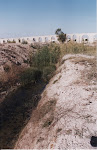
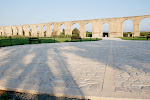
At the exit from Larnaka towards the Limassol highway you see the most grandiose arches (kamares) of the 16 kilometers long, 18th century aqueduct of Larnaka. For the adventurer the old aqueduct of Larnaka offers a tremendous challenge. Walking straight line from these 1st arches at about 2-3 kilometers you arrive at the 2nd arches and after a walk of almost the same distance, but having to pass the airport “by-pass highway” you arrive at the 3rd and lower in height arches. At this point you have to look for the old mill, which was working with the aqueduct’s water, and then for almost 9 kilometers up to the river, the water-channel becomes underground, but every 30 meters you can see the “visiting wells” of this unbelievable project, which channeled the water of river Tremithos to Larnaka till the 1930’s. Many researchers and historians believe that this tremendous public work existed since Roman times and that the Ottoman Bekir Pashia reconstructed the whole project in 1745 on the basis of the surviving facilities. This argument is supported by the fact that a similar in construction and materials water channel exist in the archaeological site of the ancient port at Kilkis Street and at many other spots in the city and these water channels remind Roman masonry as does at several points the main aqueduct line underground or over the ground.
Kimon Square and Seafront Stage
Kimon Square is in the middle of Athens Avenue, and was named in the 1920’s to honor Athenian General Kimon, who in the 5th century BC arrived here with 200 triremes to free Cyprus from Persian rule. He besieged Kition (Larnaka), which was the stronghold of the Persians and he defeated the Persian fleet in the nearby open sea. He died here before final victory and his army, according to ancient historians, buried him in Larnaka and the people of Kition honored him since. General Kimon’s bust is an artwork of an Athenian sculptor and was placed here in the 1920’s. Next to the bust the municipality of Larnaka constructed the open air “Seafront Stage” where all free of charge summer festivities of the town are taking place. Of special interest are the Cataclysm’s festivities of the Pentecost in early June, where the Square is visited by thousands of people from all over Cyprus.
Larnaka Marina and the Colonial Pier
Opposite the colonial buildings of Europe Square is the entrance of the Larnaka Marina, which was built in the early 1970’s all around the Colonial Pier, which was constructed by the British in 1879 to develop the facilities of the Larnaka port at that time. The walk on the Pier is a traditional social activity of the people of Larnaka and it is strongly recommended because it is the only place you can have a look at the Larnaka seafront from the side of the sea and at the same time enjoy the feeling of a real sea-town where activities are extended in the open sea. All organized mini cruises in the Larnaka Bay and to Ayia Napa and Protaras areas start from here and you can even choose a glass bottom boat to enjoy the deep, or you can chart your own yacht for a day cruise of your choice. Also, you can enjoy a submarine underwater mini cruise in the Larnaka Bay, which is full of smaller and bigger wrecks, the most famous being the Zenovia.
Europe Square
It is at the beginning of Athens Avenue and it is decorated with the first colonial buildings the British Administration built in Cyprus in 1879. It was the first year the British occupied the island and Larnaka was the biggest port and urban center of the island, so the housing of British colonial administration had to get started from here. The Colony’s Governor building, the chief Port Master house and office, the Chief Customs Officer residence and office, the colonial port warehouses are some of these old buildings now restored to accommodate the Paleontology museum, the Municipal Gallery of Modern Art, the City-Museum and Archives and the District Administration of Larnaka. The restoration of the old colonial warehouses won the “Europa Nostra” award in 1996. The artistic composition “seagulls in flight” of sculptor Papagiannis was also placed in 1996, updating the area, and ‘Europe Square’ name was given by the Municipal Council to honor the European Union.
Palm Trees Promenade
One of the most pleasant entertainment seafront areas of the whole of Cyprus is the palm trees promenade or Athens Avenue in Larnaka. This beautiful avenue along a sandy beach on the popular seafront of the city accommodates some of the best hotels, cafes, pubs, clubs and restaurants in town. Along this famous “Phinicoudes” sandy beach of Larnaka, which is busy and friendly day and night summer, winter, springtime and fall, activity is a non-stop procedure, as the beach fans and swimmers mingle with the tourists visiting the museums, the historic buildings and all of them together with the locals enjoy the drinks, food and entertainment of the establishments and the free of charge walks on the promenade. Famous urban planner Angelos Demetriou designed the area in the early 1990’s and this new beautiful and pleasant municipal town project replaced the previous municipal setting of Mayors F. Zanettos and N. Kyriazis, who were also responsible for the plantation of the palm trees (phinicoudes) in the early 1920’s.
Larnaka Salt Lake
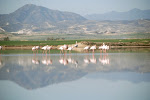
The first site of immense interest encountered upon arrival at the Larnaka international airport is the Larnaka salt lake. Its past as a natural habitat of sea life is traced 3 million years BC and fossil life of that age can be found in the surrounding hills. The central salt lake in prehistoric times was a gulf. From 1700 BC was a secure natural port in the service of the large prehistoric town next to Hala Sultan Tekke, which was abandoned by its population at about 1050 BC, at about the time the gulf was closed, the natural port was destroyed and the central salt lake was formed. As excavations in the area show, this is perhaps one of the first natural ports of Cyprus that facilitated trade between Cyprus and the great civilizations of the area at the birth of international seafaring exchanges. The porphyra - red dies using the juices of the murex-shells, which were in abundance in the gulf and until now in the Larnaka bay, was one of the important and expensive exports of this prehistoric town and of Kition, the nearby town that succeeded. Salt was another expensive prehistoric product of the lake, which was extremely exploited through the centuries till a few years ago. Historians of Hellenistic, Roman, Frankish and Ottoman times report the great quality of this salt and its great income due to the exports. But, the most interesting thing about the salt lake today is the migration of birds in winter. These bird migrations include flamingos, ducks, swans and tens of other flying species. Such a rich hunting place did not escape the attention of the ancient, who had at the shores of the salt lake one of the most famous temples of Atremis- paralia (Diana of the seafront) goddess of hunt. Hunting is no more allowed, but watching the birds, walking the interesting surroundings and enjoying the famous red sunsets of the spot are strongly recommended. In the wider salt lake area covering about 5 square kilometers there are actually 4 lakes of exceptional natural habitat looked after by the Committee for the Protection of the Larnaka Salt Lakes, which is authorized under a relative Cyprus Law.
The Larnaca Castle
At the end of Athens Avenue, you cannot miss the Larnaka Castle. The Byzantines founded a first fortification on the spot in the 12th century. But, the first written source about the castle is of the 14th century. Chronographer Florius Boustronius dates it during the years of Luzignian King James I (1382-1398AD), who built it to protect the harbor of the town. It is the time that the Genovese occupied Famagusta and the Luzignians had to develop another major port for the needs of their kingdom. It is recorded in 18th century sources that the castle was built by the Turks in 1625 AD, since it was in a semi-ruinous state at that time, even though a Turkish garrison was maintained there since 1570 AD. The English used it as a prison and place for execution of death convicts up to 1948.
Pambula and the ancient port (700BC – 300AD)
Behind the Larnaka District Museum on the Pambula hill, which is secluded by Kilkis and Kimonos Streets, excavations started in the 1930’s. Temples of Hercules and Aphrodite were firstly uncovered. In the 1970’s a French archaeological mission excavates every year the site as great discoveries were made here. The greatest is the ancient port of the city Kingdom of the classical years, which was found almost intact. This port is in a better condition that any other ancient man-made port ever discovered. Visits at the site are allowed only after permission of the Director of the Larnaka District Museum.
Prehistoric site near Hala Sultan Tekke
The largest prehistoric town of Cyprus was uncovered near the Hala Sultan Teke
by a Swedish archaeological mission. This discovery was made in the late 1970’s
and the excavations continued till the 1990’s. This prehistoric town had its port in
the central salt lake as it was then open to sea. The town lived from about
1700 BC to 1000 BC. The rich finds are displayed in the Nicosia and
Larnaka District Museums, but the site displays some very interesting stone built
wells and toilets, which are within the private houses of this advanced for its
times town. Visits are allowed only after an approval by the Director of the
Larnaka District Museum.
Ancient Kition (kathari)
This archaeological site on Pasicratous Street is one of the first sites that the Cyprus Department of Antiquities excavated after independence in the early 1960’s. It is here that it was clearly found that the Mycenaean Greeks arrived in Larnaka in the 13th century BC and the Phoenicians in the 9th. The site is the Temple area of the ancient city Kingdom of Kition. In the same area exist Egyptian style Temples of the 18th Egyptian Dynasty, which are older than the Greek and served the eteocypriot (pre-Hellenic) population. Besides the Temples the archaeologists uncovered here the history of the cyclopean walls and the history of the copper metallurgy of the town. The site can be visited on a daily basis during working hours and the most interesting architectural remains are those of the Temple of Aphrodite – Astarte built by the same Phoenician masonry that built the Temple of Solomon in Jerusalem the same period (9th century BC).
Medieval Museum
At the end of the palm trees promenade on Athens Av. and on the second floor of the Larnaka Castle (Tel.24304576) you can visit interesting museum collections of Early Christian period (4-7th centuries), Byzantine wall-paintings of the 11-16th centuries, Medieval glazed pottery from the 12-18th century, helmets and swords of the Venetian period (15-16th century), metal cooking utensils of the Ottoman period (18-19th century). In the open yard of this castle, which accommodates a 600 seat open-air theatre, a collection of Ottoman canons is also in display.
City Museum and Archives
This municipal museum is housed in the restored residence and office of the first colonial Port Master of Larnaka built in 1881 (Tel.24657745). On the ground floor operate the City museum with exhibits emphasizing the long, glorious and uninterrupted history of the town. A large collection of the city’s coins minted in the local mint starting with the first coin of the city Kingdom of Kition of the late 6th century and a fabulous collection of city’s photographs through the years starting with one of the year 1850 are among the most interesting exhibits. On the second floor operate the city’s archives, which are open only for the researchers as they include rare books, editions and documents.
Museum of Paleontology
On Europe Square and in the old colonial style Customs warehouse operates the Pierides – Tornarides museum of Paleontology (Tel.24629333). This is the only museum of its kind in Cyprus and houses a unique collection of fossil life covering 500 million years. Among the rare local exhibits there are bones from pygmy elephants and hippopotamus, which ceased to exist on the island only around the year 10.000 B.C.
Larnaca District Archaeological Museum
Situated at Parides Square (ex Kalogreon) (Tel.24304169), this government museum house a collection of archaeological finds from the Larnaka town and District. It includes exhibits of Neolithic times, Copper Era, Archaic, Classical, Hellenistic and Roman periods. Besides the large collection of local made pieces it also displays some unique items found in the Larnaka area, but they are of Egyptian, Mycenaean, Phoenician, Assyrian and Persian origin or have been imported from some of the other great nearby civilizations of antiquity.
Pierides Foundation Museum
On Zenonos Kitieos street No.4 (Tel. 24814555) the Pierides museum exhibits a fascinating private collection of Cypriot antiquities acquired over the years from 1839 by five generations of the Pierides family, one of the most well known families of Larnaka. It is housed on an old family mansion house built in 1840. It includes exhibits from the Neolithic times, Copper Era, Mycenaean, Archaic, Classical, Hellenistic, Roman, Byzantine, Frankish, Venetian and Ottoman periods. This unique museum covers 9000 years of Cypriot art.
Other Places of Worship
In Larnaka you can worship your God, no matter a Christian Anglican, Armenian, Evangelical, Catholic, Orthodox or Moslem. The Anglican worship at St. Helena’s church at Ag. Elenis Street (tel 24622327), the Armenians at Saint Stefan’s church, Armenian Church Street (tel. 24654435), the Evangelists at Apostolidou-Lenas Street (tel.24657057, 24652331), the Catholics at Terra Santa church (tel.24652858), Orthodox in the numerous Orthodox churches in town, which have regular Services every Sunday 8-9+30am. The Moslems can worship at the historical Beyuk Mosque, Ankara Street, opposite the Larnaka Castle, which is also open for prayers on a regular and daily basis.
Panayia Phaneromeni
A small elegant church of the early 20th century devoted to Virgin Mary on
Phaneromeni Avenue. The present structure has replaced a medieval church on the same spot. The cave underneath served as an early Christian church. This cave was originally a royal monolithic tomb of the town’s prehistoric times, probably Mycenaean Greek. Today a larger Church is built near the older to serve the expanding community of the parish.
Phaneromeni Avenue. The present structure has replaced a medieval church on the same spot. The cave underneath served as an early Christian church. This cave was originally a royal monolithic tomb of the town’s prehistoric times, probably Mycenaean Greek. Today a larger Church is built near the older to serve the expanding community of the parish.
Subscribe to:
Posts (Atom)