


 Posts
Posts



Tuesday, November 4, 2008
Palm Trees Promenade
One of the most pleasant entertainment seafront areas of the whole of Cyprus is the palm trees promenade or Athens Avenue in Larnaka. This beautiful avenue along a sandy beach on the popular seafront of the city accommodates some of the best hotels, cafes, pubs, clubs and restaurants in town. Along this famous “Phinicoudes” sandy beach of Larnaka, which is busy and friendly day and night summer, winter, springtime and fall, activity is a non-stop procedure, as the beach fans and swimmers mingle with the tourists visiting the museums, the historic buildings and all of them together with the locals enjoy the drinks, food and entertainment of the establishments and the free of charge walks on the promenade. Famous urban planner Angelos Demetriou designed the area in the early 1990’s and this new beautiful and pleasant municipal town project replaced the previous municipal setting of Mayors F. Zanettos and N. Kyriazis, who were also responsible for the plantation of the palm trees (phinicoudes) in the early 1920’s.

Larnaka Salt Lake
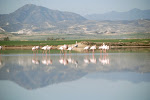
The first site of immense interest encountered upon arrival at the Larnaka international airport is the Larnaka salt lake. Its past as a natural habitat of sea life is traced 3 million years BC and fossil life of that age can be found in the surrounding hills. The central salt lake in prehistoric times was a gulf. From 1700 BC was a secure natural port in the service of the large prehistoric town next to Hala Sultan Tekke, which was abandoned by its population at about 1050 BC, at about the time the gulf was closed, the natural port was destroyed and the central salt lake was formed. As excavations in the area show, this is perhaps one of the first natural ports of Cyprus that facilitated trade between Cyprus and the great civilizations of the area at the birth of international seafaring exchanges. The porphyra - red dies using the juices of the murex-shells, which were in abundance in the gulf and until now in the Larnaka bay, was one of the important and expensive exports of this prehistoric town and of Kition, the nearby town that succeeded. Salt was another expensive prehistoric product of the lake, which was extremely exploited through the centuries till a few years ago. Historians of Hellenistic, Roman, Frankish and Ottoman times report the great quality of this salt and its great income due to the exports. But, the most interesting thing about the salt lake today is the migration of birds in winter. These bird migrations include flamingos, ducks, swans and tens of other flying species. Such a rich hunting place did not escape the attention of the ancient, who had at the shores of the salt lake one of the most famous temples of Atremis- paralia (Diana of the seafront) goddess of hunt. Hunting is no more allowed, but watching the birds, walking the interesting surroundings and enjoying the famous red sunsets of the spot are strongly recommended. In the wider salt lake area covering about 5 square kilometers there are actually 4 lakes of exceptional natural habitat looked after by the Committee for the Protection of the Larnaka Salt Lakes, which is authorized under a relative Cyprus Law.
The Larnaca Castle
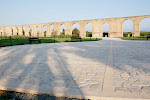
At the end of Athens Avenue, you cannot miss the Larnaka Castle. The Byzantines founded a first fortification on the spot in the 12th century. But, the first written source about the castle is of the 14th century. Chronographer Florius Boustronius dates it during the years of Luzignian King James I (1382-1398AD), who built it to protect the harbor of the town. It is the time that the Genovese occupied Famagusta and the Luzignians had to develop another major port for the needs of their kingdom. It is recorded in 18th century sources that the castle was built by the Turks in 1625 AD, since it was in a semi-ruinous state at that time, even though a Turkish garrison was maintained there since 1570 AD. The English used it as a prison and place for execution of death convicts up to 1948.
Pambula and the ancient port (700BC – 300AD)
Behind the Larnaka District Museum on the Pambula hill, which is secluded by Kilkis and Kimonos Streets, excavations started in the 1930’s. Temples of Hercules and Aphrodite were firstly uncovered. In the 1970’s a French archaeological mission excavates every year the site as great discoveries were made here. The greatest is the ancient port of the city Kingdom of the classical years, which was found almost intact. This port is in a better condition that any other ancient man-made port ever discovered. Visits at the site are allowed only after permission of the Director of the Larnaka District Museum.
Prehistoric site near Hala Sultan Tekke
The largest prehistoric town of Cyprus was uncovered near the Hala Sultan Teke
by a Swedish archaeological mission. This discovery was made in the late 1970’s
and the excavations continued till the 1990’s. This prehistoric town had its port in
the central salt lake as it was then open to sea. The town lived from about
1700 BC to 1000 BC. The rich finds are displayed in the Nicosia and
Larnaka District Museums, but the site displays some very interesting stone built
wells and toilets, which are within the private houses of this advanced for its
times town. Visits are allowed only after an approval by the Director of the
Larnaka District Museum.
by a Swedish archaeological mission. This discovery was made in the late 1970’s
and the excavations continued till the 1990’s. This prehistoric town had its port in
the central salt lake as it was then open to sea. The town lived from about
1700 BC to 1000 BC. The rich finds are displayed in the Nicosia and
Larnaka District Museums, but the site displays some very interesting stone built
wells and toilets, which are within the private houses of this advanced for its
times town. Visits are allowed only after an approval by the Director of the
Larnaka District Museum.
Ancient Kition (kathari)
This archaeological site on Pasicratous Street is one of the first sites that the Cyprus Department of Antiquities excavated after independence in the early 1960’s. It is here that it was clearly found that the Mycenaean Greeks arrived in Larnaka in the 13th century BC and the Phoenicians in the 9th. The site is the Temple area of the ancient city Kingdom of Kition. In the same area exist Egyptian style Temples of the 18th Egyptian Dynasty, which are older than the Greek and served the eteocypriot (pre-Hellenic) population. Besides the Temples the archaeologists uncovered here the history of the cyclopean walls and the history of the copper metallurgy of the town. The site can be visited on a daily basis during working hours and the most interesting architectural remains are those of the Temple of Aphrodite – Astarte built by the same Phoenician masonry that built the Temple of Solomon in Jerusalem the same period (9th century BC).
Medieval Museum
At the end of the palm trees promenade on Athens Av. and on the second floor of the Larnaka Castle (Tel.24304576) you can visit interesting museum collections of Early Christian period (4-7th centuries), Byzantine wall-paintings of the 11-16th centuries, Medieval glazed pottery from the 12-18th century, helmets and swords of the Venetian period (15-16th century), metal cooking utensils of the Ottoman period (18-19th century). In the open yard of this castle, which accommodates a 600 seat open-air theatre, a collection of Ottoman canons is also in display.
Subscribe to:
Posts (Atom)